Sunday, March 4, 2012

Guyku A Year of Haiku for Boys


Bibliography
Raczka, Bob. 2010. Guyku A Year of Haiku for Boys. Houghton Mifflin Books for Children. New York: NY. ISBN: 978-0-547-24003-9.

About the Book
Haiku, a particularly mathematical poetic form, is naturally appealing to boys.  This collection, in particular, was written expressly to appeal to early elementary school boys.  Guiding readers through the seasons, each haiku presents a topic that is universally enjoyable by boys in this age group.  From catching grasshoppers, to skipping rocks and many other "boyish" activities, readers will enjoy this short, easy to read poetic form.  Additionally, the science tie-in of things in nature and outdoor events are also topics boys (and girls!) will love. Raczka maintains the requirements of haiku, with this focus on seasons and nature, and writes a series of six poems per season. This collection could by read by children or shared with children by an adult.  The presentation of one haiku and adorable drawings on each page make it extremely inviting. 

One Poem
If this puddle could
talk, I think it would tell me
to splash my sister. 

Activities
*Poetry Break - read the above Haiku and discuss what else might we hear if something in nature could talk.
* After reading this collection, invite students to choose a topic and write a collaborative class poem about something in nature.
* Share other books of haiku, such as Won Ton: A Cat Tale Told in Haiku by Lee Wardlaw. Discuss how the presentation of this book is different from Guyku.
*Explore the website www.GuykuHaiku.com and then allow students to explore it as well. 


Inside Out & Back Again

Bibliography
Lai, Thanhha. 2011. Inside Out & Back Again. Harper Collins Children's Books. New York:NY. 978-0-06-196278.

About the Book
This verse novel is a new historical fiction that could also enhance a multicultural collection in a children's or young adult section. The short lines and appearance of the text on each page helps reluctant readers or possibly ESL students feel that this novel is more manageable for them to read. The story presented by Ms. Lai is taken from her own life experience of moving from Vietnam in 1975 to Alabama.  Her first introductions to school, American traditions (such as Christmas), and the trials her entire family experience as they try to find their place in this new world.  Since her father has been missing for nine years in the Vietnam War, Ha (the main character) flees with her mother and three brothers by boat to Guam, then Florida, and finally to Alabama where they meet their sponsor. This simple presentation of the hardships and rewards of those immigrants who move to America is eye-opening and helps the reader evaluate his or her own reaction to people in this difficult situation. Lai artfully presents her realistic descriptions in a sequenced narrative that is historically significant through her use of believable characters and dramatic situations. I would recommend this book for library collections that service patrons from grades 4 - 8. 


Book Excerpt
As soon as I remove my coat,
everyone stops talking.


A girl in red velvet 
comes over to me.
Don't ya know flannel 
is for nightgowns and sheets?

I panic.

The red-velvet girl 
points to the middle
of my chest.
See this flower?
They only put that
on nightgowns.

I look down
at the tiny blue flower
barely stitched on.

I rip it off.
Nightgown no more.  

Activities
*Reader's Theater- using multiple copies of the book, assign characters, including Ha, the narrator and allow students to read a selected excerpt from the book.
*After reading the selected excerpt above aloud to the class, instruct students to write a passage describing a situation that they might find themselves in, such as wearing pajamas as regular clothes.
*After reading this novel, ask students to read another historical or realistic fiction novel and compare the character's experiences.

Sunday, February 12, 2012

Bing Bang Boing

Bibliography
Florian, Douglas. 1994. Bing Bang Boing. Harcourt Brace & Company: Orlando. ISBN: 0-15-200802-0. 

About the Book
This big collection of rhymes and verse is most appropriate for older elementary students and is sure to get a laugh.  Some poems are visual (for example Book Crooks, "T ey  stol  some  let ers") and some are enjoyable to listen to (for example Strange Change, "An enterprising wizard / Turned Aunt Fay into a lizard.") Florian's collection has surprises including nonsense verse, which probably is what causes students to enjoy it so much. Most of the poems are end rhyme and are somewhat predictable which can be fun for reading aloud as students try to guess the word the poet used to finish the line. Each two page layout has two, three, or four short poems so the reader easily moves from poem to poem. The illustrations are done by Florian himself and are somewhat rudimentary.  The thick line drawings are simplistic and boring and do not particularly add anything to the poems.  However, the illustrations can be used to encourage students to write and illustrate their own poems. 


One Poem


Twinkle, Twinkle


Twinkle, twinkle, little star,
How I wonder what you are - 
     A sphere of incandescent gas
     Spinning round a nuclear mass.
Twinkle, twinkle, little star,
How I wonder what you are. 


Activities
*Before reading the poetry collection, discuss with students different ideas about what poetry is.  Lead them to discuss how some people think that all poetry rhymes.  Have some examples of non-rhyming poems ready.  Then read the poems from this collection and identify how the poet had to choose words carefully in order to get his ideas across using this end rhyme style. 
*Poetry Break- using "Twinkle Twinkle."  Before or after a science lesson about planets or the solar system, read this variation on a familiar rhyme.  Briefly discuss the two new lines and their scientific basis, relating them to the science lesson.
*Read other Douglas Florian poetry collections.  Compare the style of poems in this collection to those in other collections.
*Lead students to choose a common subject (like a pet) and write a collaborative class poem in the style Florian wrote the silly rhymes in this collection. 
*Encourage students to write and illustrate their own simple rhymes by choosing a familiar subject and writing a poem about it.

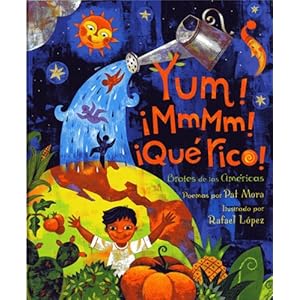
Yum! ¡MmMm! ¡Que´ rico!

Bibliography
Mora, Pat. 2007. Yum! ¡MmMm! ¡Que´ Rico! Lee & Low Books, Inc.: New York. ISBN: 978-0-329-70160-4.


About the Book
This unique collection of Haiku has something for everyone.  On the left of each page is a brief informative description of a food (for example, Potato) giving a probable origin, history, and trivia. On the right page is a Haiku about the edible plants native to the Americas.  The two page illustrations are interesting, intriguing, and appropriate for this genre.  The foods and places highlighted are traditional in the southwest, including Mexico and Texas, among others. The poems capture the flavor of the item in a way children can easily understand. "Chocolate: Fudge, cake, pie, cookies. / Brown magic melts on your tongue." The language used is light and kid-friendly and includes a few simple Spanish words which are defined on the title page verso. Everyone who eats food will enjoy this collection. 

One Poem
Pecan

We crack hard, brown shells,
family munching, story time,
crunch taste of fall.


Activities
*Poetry Break - Using the poem "Pecan." In a transition time, between subjects or while preparing to head out of the classroom, share this short poem.  Discuss the language ('munching') and possible setting (fall).  Also talk about what a family story time might be like - what might the stories be about?

*Bring in familiar and some of the uncommon foods mentioned in the collection.  Research more information about them - where they grow, in what season they are best, etc. - and allow the students to taste samples of each variety. 
*Allow students in the class to vote on their favorite natural foods.  Find out their source and name the food in Spanish. Make a graph depicting the food choices or their origin.
*Grow a simple plant (bean sprout, for example) by allowing each student to place soil and a seed in a cup.  Watch the growth and keep a journal documenting their observations. 
*Read other collections by Pat Mora and compare them to the Haiku included in this collection. 

Please Bury Me in the Library


Bibliography
Lewis, J. Patrick. 2005. Please Bury Me in the Library. Harcourt, Inc: Orlando. ISBN: 978-1-415-59351-6.

About the Book
This collection of poems were all written by J. Patrick Lewis, the 2011 National Council of Teachers of English poetry award winner. The poems in this collection highlight all the essential elements of English: letters ("Eating Alphabet Soup"), words ("The Big-Word Girl"), and books ("Great, Good, Bad"). The types of poetry included in the book range from Haiku to simple rhymes which are naturally appealing to children. Lewis references topics and classic works that the audience can relate to- reading at the beach, eating alphabet soup, going to the library, and titles of classic works that many can remember. Each poem included in this collection is newly published, except for two which were published previously in a book of Lewis' poems. 
The appealing layout of the poems, along with great illustrations that are large, colorful, and creative make the book something to be enjoyed by audiences young and old.  Although the book appears to be a picture book, the poems inside offer something unique to reading.  The book also includes a table of contents which allows readers to easily return to favorites they are sure to revisit. 


One Poem
What if Books Had Different Names?

What if books had different names
Like Alice in....Underland?
Furious George,
Goodnight Noon,
Babar the Beaver, and
A Visit from Saint Tickle Us,
Or Winnie-the-Pooh Pooh-Poohs,
The Walrus and the Carp and Her,
The Emperor Has No Clues,
Or Mary Had a Little Clam,
And how about Green Eggs and Spam? 
Well, surely you can think of one.
Oh, what extraordinary, merry
Huckleberry Funn! 

Activities
* Read other books by J. Patrick Lewis and discuss the similarities and differences in the collections.
* After reading "What if Books Had Different Names," brainstorm some other familiar titles and come up with more fun and creative alternatives.
*After reading "What if Books Had Different Names," re-write one of the works referenced according to the new title.  For example, rework "The Emperor Had No Clues" to be a mystery/detective story using the original story as a framework.
*After reading "Please Bury Me in the Library," discuss book genres (novels, history, poetry, etc) and go to the library to find examples of each.

Tuesday, January 31, 2012

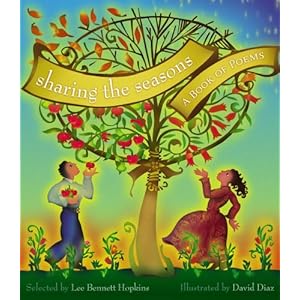
Sharing the Seasons - A Book of Poems


Bibliography
Hopkins, Lee Bennett. 2010. New York: Margaret K. McElderry Books. ISBN: 978-1-4169-0210-2.


About the Book
This collection of poetry about the four seasons offers twelve poems about each season. Lee Bennett Hopkins weaves a nice selection of poets and their poems into a single book.  Quotes from famous sources begin each season.  For example, Spring is introduced with Henry Wadsworth Longfellow's "Spring in the world! And all things are made new!" The entire collection effectively taps into the elements in each season and speaks to both children and adults. The poem by James Hayford, "Suddenly Green" says that "Our trees have grown skin / And birds have moved in." Rebecca Kai Dotlich is "Bewitched by Autumn," conjuring up Halloween with the "bits of legend in a broth".  By the end of the collection, every season has had its voice - serving as quite a tribute to nature. 

Vibrant illustrations perfectly accompany each poem so that children are able to enjoy each verse as well as each visual page. Teaching the concept of seasons can be challenging for those working with young children so these short, clear poems are perfect for use with that group.  Because of the brevity of each poem, several can be shared in one sitting. Many of the entries personify nature, such as in April Halprin Wayland's whimsical selection which portrays spring flowers showing up for a first day of class: "Let's go around the room / Call out your colors." Other poems focus on human activities throughout the year and the small, sensory moments that make each season special - smelling cool spring air; listening to the crackle of a December fire.

One Poem

Winter
Lee Bennett Hopkins

Snowballs
snow people
icicles
frost

always - 
always - 
a mitten or two lost

scarves
boots
earmuffs
sleighs

and 
books 
to curl up with
on 
long
wintry
days.

Activities
As an introduction to the book, create a simple KWL chart, guiding students to discuss features of each season.  Provide non-fiction books about each season to assist students, if needed. Students can choose a favorite season to illustrate and place their picture on a table or butcher paper banner with the name of each season on it. Discuss seasons and how they impact us - including what we see, how we dress, or what we do.  

After reading poems from the book, introduce another book about seasons, such as Seasons All Around by Barney Satlzburg, Candlewick Press, 2010. Compare the format and genre of each book. Discuss the special features of poetry and non-fiction and how each book exhibits those features.

As a science tie-in, lead students to conduct research about average temperatures, rainfall, or other regional statistics for each season in the area in which they live.

Hip Hop Speaks to Children

Bibliography
Giovanni, Nikki, ed. Hip Hop Speaks to Children a Celebration of Poetry with a Beat. 2008. Naperville, Illinois: Sourcebooks, Inc. ISBN: 978-1-4022-1048-8.

About the Book
Poetry can have rhythm or rhyme or both.  Sometimes it is obvious and can be detected easily but sometimes it is less obvious. But poetry is vibrant and exciting, and showing that to kids is a great experience.  When you find yourself involuntarily clapping your hands or tapping your feet, you have surely found the beat of poetry.  This book will, no doubt, help kids hear rhyme, feel rhythms, and enjoy poetry. Designed and compiled to give voice, specifically, to African American children - though it is universally enjoyable - this book/CD combination accomplishes its goal. This is a remarkable collection of more than 50 songs and poems including an excerpt from the famous Martin Luther King, Jr. speech, "I Have A Dream." The illustrations are beautiful and the audio CD is enjoyable.  When they are put together, this resource is a delight.The poems included in the book were written by a very diverse group of people including Maya Angelou, Langston Hughes, Eloise Greenfield, Gary Soto, and Walter Dean Meyers. Then there are the musicians who have written poems, including Queen Latifah, Aesop Rock, and Young MC.  The book comes with a CD which includes readings by Queen Latifah, Gwendolyn Brooks, Langston Hughes, and many more. The book alone, or along with the CD, is a great introduction to poetry and is a fun way to explore poetry with kids.  

 The poems are about a variety of subjects, many of which have a powerful and meaningful message. Tupac Shakur writes about a rose "that grew from the concrete." Nikki Giovanni's The Rosa Parks encourages children to "do the rosa parks" and "shame the bad / comfort the good." The words are simple, punchy, and to the point, and they remind children that they are the ones who can make the world a better place. What a great message for today's children! The following poem is an example of poems in this collection.

One Poem

People Equal
by James Berry

Some people shoot up tall.
Some hardly leave the ground at all.
yet - people equal. Equal.

One voice is a sweet mango.
Another is a nonsugar tomato.
yet -  people equal. Equal. 

Some people rush to the front.
Others hang back, feeling they can't.
yet -  people equal. Equal.

Hammer some people, you meet a wall.
Blow hard on others, they fall.
yet -  people equal. Equal.

One person will aim at a star.
For another, a hilltop is too far.
yet -  people equal. Equal.

Some people get on with their show.
Others never get on the go.
yet - people equal. Equal.

Activities
The back of the book provides readers with more about the poets and musicians who contributed to the book.  Use this resource to research poets and musicians from other types of collections.

Have students work as a team to write a poem that could be added to this collection.  Brainstorm other types of poetry collections that could be put together - show some examples from the library.  Write a class poem that could be included in another collection.

Tie in to a social studies lesson about cultures.  Discuss how the poems and songs in this collection are specifically written to honor African-American children.  Think about other cultures in the community in which students live. Search poems and songs that could be compiled into a collection to honor another culture.