Thursday, April 12, 2012

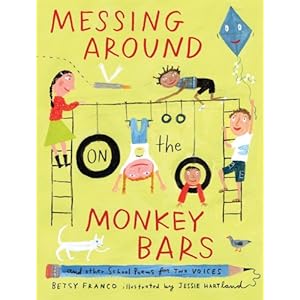
Messing Around on the Monkey Bars


Bibliography
Franco, Betsy. 2009. Messing Around on the Monkey Bars. Candlewick Press: Massachusetts. ISBN: 978-0-7636-3174-1.

About the Book
This collection of 19 school poems are designed for two or more voices and is perfect for students in grades two through four. The steady rhymes and humor are sure to appeal to students and teachers alike. The poems in this collection cover a variety of topics from losing one's lunch money to reaching out to a new classmate to exasperating a grumpy librarian. The reading and rereading of the poems will allow students to hear different voices read in slightly different ways.  Also students can practice fluency while reading the short poems over again.  These poems will lend themselves to performing them in different ways.  For example one person could read one part, but several children could read the other part.  

One Poem
Lunch Money
It's lunchtime. Yum!
Quick, get in line.

What's good today?
Cant' read the sign.

My money's missing!
Where'd it go?  

A hole in my pocket!
Oh, no!

I'll go and look.
I'll save your spot. 

I couldn't find it!
Look what I got.

Two burritos! Way to go!
You're a buddy, don't ya know? 

What a pal.
Yeah, luck I found...

a bunch of quarter on the ground.
 
Activities
*Read the poem and discuss how it depicts friends, lunchtime, or problem solving.  
*Read other poems from the collection and compare their language, theme, rhythm, rhyme scheme or other aspect. 
*Locate other poems or collections designed for two or more voices. 
 

Wednesday, April 11, 2012

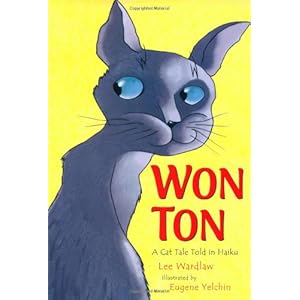
Won Ton A Cat Tale Told in Haiku

Bibliography
Wardlaw, Lee. 2011. Won Ton A Cat Tale Told in Haiku. Henry Holt and Company: New York. ISBN 978-0-8050-8995-0.

About the book
This series of senryu (similar to haiku, but focuses on human nature - or in this case, nature of an animal - rather than focusing on the natural world) tells a great story of a cat's journey from a shelter to a home with a boy.  Children especially in grades kindergarten through third grades will enjoy both the poems/story and the illustrations.  This nice example of non-rhyming poetry can teach children about syllables and styles of poems. The collection shows that poetry can be fun, free, and still follow traditional structure; for example: "The Car Ride," reads, "Letmeoutletme/ outletmeoutletmeout./ Wait - let me back in!" The expressive artwork, done in graphite-and-gouache, relate to the poetic form's roots and echoes the Japanese traditions.  This book was honored with the Lee Bennett Hopkins 2012 Poetry Award.


One Poem
Your tummy, soft as
warm dough.  I knead and knead, then
bake it with a nap. 


Activities
*Share the poem (or better, the entire book) with the class and talk about cat's behavior and how the poet so clearly describes typical cat actions.  
*Invite a worker from a local animal shelter to talk about how animals are chosen.  Compare the worker's description to the one told through poetry in the book.
*Read other Lee Bennett Hopkins Poetry Award winners and compare how the poets use words, rhyme, meter, and other poetic features to express themselves. 

Tuesday, April 10, 2012

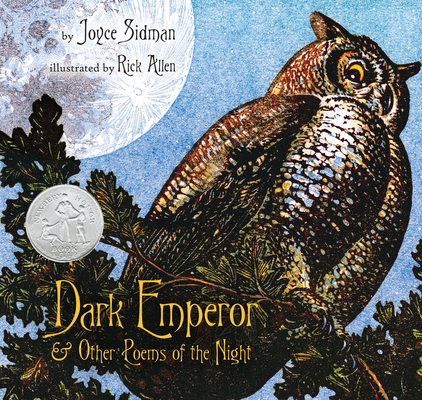
Dark Emperor & other Poems of the Night


Bibliography
Sidman, Joyce. 2010. Dark Emperor & Other Poems of the Night. Houghton Mifflin Books for Children: New York. ISBN 978-0-329-85965-7.

About the Book
Sidman's collection of poems celebrates the wonder, mystery, and danger of the night, describing the many things that hide in the dark. The book, geared for students in grades three through six, is a Newberry Honor book. The combination of lyrical poetry and compelling art with science concepts makes it a great cross curricular tie in. Exciting biology facts are explained in the notes on the right side of each two-page spread while the poem is presented on the left.  The science facts are further reinforced by the accompanying picture. A glossary at the end of the book provides readers with a brief definition of words used in the poems.  This book is a valuable collection of poems that can be used to reinforce science concepts through the poems, the illustrations, and the factual information presented. 

One Poem
Love Poem of the Primrose Moth


Evening unfolds like a primrose,
pale and scented.


The moon, a primrose:
two faces glowing.


Which is sweeter: night flight
or the nectar of the primrose?


I have only one true love:
it is the primrose.


At dawn, I fold my sherbet-colored wings
and become
                    a primrose.

Activities
*In conjunction with a lesson about insects, read this poem aloud to students.  Discuss the language and vocabulary used and why the poet chose those particular words. Additionally, share the factual information on the page about moths.
*Read other poetry collections by Joyce Sidman and compare the content and styles used in both collections.
*After reading the poem and discussing it, provide an art tie-in.  When students know what a primrose flower and a primrose moth are, allow them to make a picture depicting one of both of them.   

Monday, April 2, 2012

Carver A Life in Poems

Bibliography
Nelson, Marilyn. 2001. Carver A Life in Poems. Front Street: Asheville, NC. ISBN: 978-1-886910-53-9.

About the Book
This biography in poems is ideal for students in grades 5-8 and represents the life of a significant African American. These poems are told in the voices of people who knew Carver and are powerful and moving.  Frank descriptions of terrible things such as lynching are also presented. One poem, potentially presenting a concern for school libraries, describes the sexual abuse of a victim. Overall, this collection gives us insight into the life of a great man whose intellect significantly impacted the world. The fifty-nine poems in this collection portray the life of George Washington Carver and give great insight into his life and the era in which he lived.


One Poem (excerpt)
Coincidence

In Wakefield the night train
screeches to a neck-wrenching halt.
Last, the explanation reaches
the Colorado compartment,
where Dr. Carver guards in a valise
his jars of Before and After soils
and of compost, his giveaway
bags of raw peanuts.

Activities
*Lead students to discuss the very visual language used in the poem excerpt. (neck-wrenching halt, for example) Discuss other words or phrases the author could have used and how they might have altered the meaning or feel of the poem.
*Read the entire poem and lead students to rephrase the poem into their own words.
*Provide a research opportunity for students about George Washington Carver and the contributions he made.
*Ask students to bring one item to class that represents a facet of Carver's life, after reading the entire collection of poems,  and explain how it is representative. 


The Brothers' War Civil War Voices in Verse

Bibliography
Lewis, J. Patrick. 2007. The Brothers' War Civil War Voices in Verse. National Geographic Society: Washington, DC. ISBN: 978-1-4263-0037-0. 

About the Book
The wonderful wordplay of J. Patrick Lewis gives a new perspective on the speeches of Lincoln, the letters of Grant and Lee, and the drama of America's Civil War. Well suited for students in grades 4 through 8, Lewis' poetry gives readers a vivid insight into the conflict that tore our country apart. The book, including eleven poems, and other features, is a beautiful representation of that era. The book's extra features, including a map and a timeline of the Civil War, notes about the photography, notes about the poem's forms and inspirations, as well as an introduction to the book, add much to the depth and significance of the book.

One Poem
Down on the Plantation

I stopped to stoop
And stooped to chop,
Then clipped to scoop
The cotton crop.

The way it went 
Long after dark.....
A woman bent
Like a question mark.

Activities
*Poetry break - read the poem, set in the early 1860s near Savannah, Georgia, and discuss the rhyme and rhythm. 
*Read other poems in the collection and compare their style and subject matter.  
*Lead students to conduct research about the Civil War era and tie the poems to social studies lessons.  Challenge students to write a poem about an aspect of the Civil War era that they learn in their research. 
*Find another collection of poems by J. Patrick Lewis and discuss how the subject matter changes the impact or purpose of the poems.

The Tree That Time Built

Bibliography
Hoberman, Mary Ann. 2009. The Tree That Time Built. Sourcebooks Jabberwocky: Naperville, Ill. ISBN: 978-1-4022-2517-8.

About the Book
This collection of poetry is a celebration of nature, science, and the environment. Each poem was selected by the Children's Poet Laureate, Mary Ann Hoberman. The anthology includes more than 100 poems celebrating the wonders of the natural world and encourages environmental awareness. Appealing especially to students in grades 3 through 7, the poems explore both the facts and the mysteries of the natural world. Grouped by subject, such as prehistory, trees, reptiles, and so on, the poems are penned by such poets as Emily Dickinson, Robert Frost, Langston Hughes, D.H. Lawrence, Jack Prelutsky, Mary Ann Hoberman, and Sylvia Plath, among others. This collection would be a great choice to use as a tool to pair science and English/language arts classes. The inclusion of features such as footnotes that encourage readers to approach the poem both rationally and imaginatively,  a bibliography, information about the poets, and a glossary with science terms really assist with the cross-curricular lesson tie-ins. 


One Poem
Cricket 
Mary Ann Hoberman


A cricket's ear is in its leg.
A cricket's chirp is in it wing.
A cricket's wing can sing a song.
A cricket's leg can hear it sing.


Imagine if your leg could hear.
Imagine if your ear could walk.
Imagine if your mouth could swing.
Imagine if your arm could talk.


Would everything feel upside down
And inside out and wrongside through?
Imagine how the world would seem
If you became a cricket, too.


Activities
*Use the poem, "Cricket" as a poetry break before introducing a unit on insects.  
*Tie in a writing lesson by having students write a paragraph, journal entry, or poem imagining the things mentioned in this poem.
*Extend the poetry lessons with other poems from this collection. Compare and contrast the poems in their style or content.
*Help students identify a poet included in this collection that they like and discover other poems by the same poet.


Sunday, March 4, 2012

A Full Moon is Rising


Bibliography
Singer, Marilyn. 2011. A Full Moon is Rising. Lee & Low Books Inc. New York, NY. ISBN: 879-1-60060-364-8.

About the Book
This new collection of poems by veteran poet Marilyn Singer takes children in grades 2-4 on an informative "lunar journey" that they are sure to love.  On the first page of the book, an explanation about the phases of the moon is included.  Readers gain background knowledge before they enjoy the short poems on each page. Students who are very interested in non-fiction subjects will be drawn into this unique group of great poems.  The collection takes the reader on a journey from Broadway, to the ocean, and even to the ancient goddess of the moon, Artemis. Readers will be enchanted by the idea that the moon that shines above all the world's peoples has created such wonder and so many traditions for generations.  The combination of descriptive poetry and eye-catching illustrations will invite children to wonder and imagine wile the multicultural themes and science facts will excite and satisfy its audience.  This title will work well as a read-aloud for younger children and independent readers will find lots to think about and appreciate.  And after taking the entire journey around the world and beyond, readers find themselves back on Broadway. 


One Poem
Broadway Moon
New York City, USA


It waits behind skyscrapers, 
a brilliant actor in the wings,
ready for its monthly debut.
On the sidewalk, an audience of one
watches and silently applauds
when it grandly appears. 


Activities
*Poetry Break - read the above poem and discuss the vocabulary that relates to stage acting.  How does the poet relate these same words to the moon?
*Geography - using the world map, locate each place mentioned in the book and mark the map with a dot.
*Science - allow students to form teams to make models of the phases of the moon.