Monday, April 2, 2012

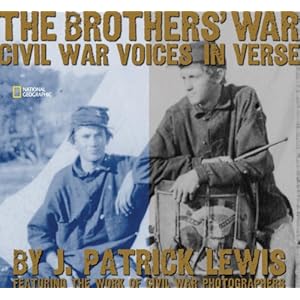
The Brothers' War Civil War Voices in Verse

Bibliography
Lewis, J. Patrick. 2007. The Brothers' War Civil War Voices in Verse. National Geographic Society: Washington, DC. ISBN: 978-1-4263-0037-0. 

About the Book
The wonderful wordplay of J. Patrick Lewis gives a new perspective on the speeches of Lincoln, the letters of Grant and Lee, and the drama of America's Civil War. Well suited for students in grades 4 through 8, Lewis' poetry gives readers a vivid insight into the conflict that tore our country apart. The book, including eleven poems, and other features, is a beautiful representation of that era. The book's extra features, including a map and a timeline of the Civil War, notes about the photography, notes about the poem's forms and inspirations, as well as an introduction to the book, add much to the depth and significance of the book.

One Poem
Down on the Plantation

I stopped to stoop
And stooped to chop,
Then clipped to scoop
The cotton crop.

The way it went 
Long after dark.....
A woman bent
Like a question mark.

Activities
*Poetry break - read the poem, set in the early 1860s near Savannah, Georgia, and discuss the rhyme and rhythm. 
*Read other poems in the collection and compare their style and subject matter.  
*Lead students to conduct research about the Civil War era and tie the poems to social studies lessons.  Challenge students to write a poem about an aspect of the Civil War era that they learn in their research. 
*Find another collection of poems by J. Patrick Lewis and discuss how the subject matter changes the impact or purpose of the poems.

The Tree That Time Built

Bibliography
Hoberman, Mary Ann. 2009. The Tree That Time Built. Sourcebooks Jabberwocky: Naperville, Ill. ISBN: 978-1-4022-2517-8.

About the Book
This collection of poetry is a celebration of nature, science, and the environment. Each poem was selected by the Children's Poet Laureate, Mary Ann Hoberman. The anthology includes more than 100 poems celebrating the wonders of the natural world and encourages environmental awareness. Appealing especially to students in grades 3 through 7, the poems explore both the facts and the mysteries of the natural world. Grouped by subject, such as prehistory, trees, reptiles, and so on, the poems are penned by such poets as Emily Dickinson, Robert Frost, Langston Hughes, D.H. Lawrence, Jack Prelutsky, Mary Ann Hoberman, and Sylvia Plath, among others. This collection would be a great choice to use as a tool to pair science and English/language arts classes. The inclusion of features such as footnotes that encourage readers to approach the poem both rationally and imaginatively,  a bibliography, information about the poets, and a glossary with science terms really assist with the cross-curricular lesson tie-ins. 


One Poem
Cricket 
Mary Ann Hoberman


A cricket's ear is in its leg.
A cricket's chirp is in it wing.
A cricket's wing can sing a song.
A cricket's leg can hear it sing.


Imagine if your leg could hear.
Imagine if your ear could walk.
Imagine if your mouth could swing.
Imagine if your arm could talk.


Would everything feel upside down
And inside out and wrongside through?
Imagine how the world would seem
If you became a cricket, too.


Activities
*Use the poem, "Cricket" as a poetry break before introducing a unit on insects.  
*Tie in a writing lesson by having students write a paragraph, journal entry, or poem imagining the things mentioned in this poem.
*Extend the poetry lessons with other poems from this collection. Compare and contrast the poems in their style or content.
*Help students identify a poet included in this collection that they like and discover other poems by the same poet.


Sunday, March 4, 2012

A Full Moon is Rising


Bibliography
Singer, Marilyn. 2011. A Full Moon is Rising. Lee & Low Books Inc. New York, NY. ISBN: 879-1-60060-364-8.

About the Book
This new collection of poems by veteran poet Marilyn Singer takes children in grades 2-4 on an informative "lunar journey" that they are sure to love.  On the first page of the book, an explanation about the phases of the moon is included.  Readers gain background knowledge before they enjoy the short poems on each page. Students who are very interested in non-fiction subjects will be drawn into this unique group of great poems.  The collection takes the reader on a journey from Broadway, to the ocean, and even to the ancient goddess of the moon, Artemis. Readers will be enchanted by the idea that the moon that shines above all the world's peoples has created such wonder and so many traditions for generations.  The combination of descriptive poetry and eye-catching illustrations will invite children to wonder and imagine wile the multicultural themes and science facts will excite and satisfy its audience.  This title will work well as a read-aloud for younger children and independent readers will find lots to think about and appreciate.  And after taking the entire journey around the world and beyond, readers find themselves back on Broadway. 


One Poem
Broadway Moon
New York City, USA


It waits behind skyscrapers, 
a brilliant actor in the wings,
ready for its monthly debut.
On the sidewalk, an audience of one
watches and silently applauds
when it grandly appears. 


Activities
*Poetry Break - read the above poem and discuss the vocabulary that relates to stage acting.  How does the poet relate these same words to the moon?
*Geography - using the world map, locate each place mentioned in the book and mark the map with a dot.
*Science - allow students to form teams to make models of the phases of the moon.

Guyku A Year of Haiku for Boys


Bibliography
Raczka, Bob. 2010. Guyku A Year of Haiku for Boys. Houghton Mifflin Books for Children. New York: NY. ISBN: 978-0-547-24003-9.

About the Book
Haiku, a particularly mathematical poetic form, is naturally appealing to boys.  This collection, in particular, was written expressly to appeal to early elementary school boys.  Guiding readers through the seasons, each haiku presents a topic that is universally enjoyable by boys in this age group.  From catching grasshoppers, to skipping rocks and many other "boyish" activities, readers will enjoy this short, easy to read poetic form.  Additionally, the science tie-in of things in nature and outdoor events are also topics boys (and girls!) will love. Raczka maintains the requirements of haiku, with this focus on seasons and nature, and writes a series of six poems per season. This collection could by read by children or shared with children by an adult.  The presentation of one haiku and adorable drawings on each page make it extremely inviting. 

One Poem
If this puddle could
talk, I think it would tell me
to splash my sister. 

Activities
*Poetry Break - read the above Haiku and discuss what else might we hear if something in nature could talk.
* After reading this collection, invite students to choose a topic and write a collaborative class poem about something in nature.
* Share other books of haiku, such as Won Ton: A Cat Tale Told in Haiku by Lee Wardlaw. Discuss how the presentation of this book is different from Guyku.
*Explore the website www.GuykuHaiku.com and then allow students to explore it as well. 


Inside Out & Back Again

Bibliography
Lai, Thanhha. 2011. Inside Out & Back Again. Harper Collins Children's Books. New York:NY. 978-0-06-196278.

About the Book
This verse novel is a new historical fiction that could also enhance a multicultural collection in a children's or young adult section. The short lines and appearance of the text on each page helps reluctant readers or possibly ESL students feel that this novel is more manageable for them to read. The story presented by Ms. Lai is taken from her own life experience of moving from Vietnam in 1975 to Alabama.  Her first introductions to school, American traditions (such as Christmas), and the trials her entire family experience as they try to find their place in this new world.  Since her father has been missing for nine years in the Vietnam War, Ha (the main character) flees with her mother and three brothers by boat to Guam, then Florida, and finally to Alabama where they meet their sponsor. This simple presentation of the hardships and rewards of those immigrants who move to America is eye-opening and helps the reader evaluate his or her own reaction to people in this difficult situation. Lai artfully presents her realistic descriptions in a sequenced narrative that is historically significant through her use of believable characters and dramatic situations. I would recommend this book for library collections that service patrons from grades 4 - 8. 


Book Excerpt
As soon as I remove my coat,
everyone stops talking.


A girl in red velvet 
comes over to me.
Don't ya know flannel 
is for nightgowns and sheets?

I panic.

The red-velvet girl 
points to the middle
of my chest.
See this flower?
They only put that
on nightgowns.

I look down
at the tiny blue flower
barely stitched on.

I rip it off.
Nightgown no more.  

Activities
*Reader's Theater- using multiple copies of the book, assign characters, including Ha, the narrator and allow students to read a selected excerpt from the book.
*After reading the selected excerpt above aloud to the class, instruct students to write a passage describing a situation that they might find themselves in, such as wearing pajamas as regular clothes.
*After reading this novel, ask students to read another historical or realistic fiction novel and compare the character's experiences.

Sunday, February 12, 2012

Bing Bang Boing

Bibliography
Florian, Douglas. 1994. Bing Bang Boing. Harcourt Brace & Company: Orlando. ISBN: 0-15-200802-0. 

About the Book
This big collection of rhymes and verse is most appropriate for older elementary students and is sure to get a laugh.  Some poems are visual (for example Book Crooks, "T ey  stol  some  let ers") and some are enjoyable to listen to (for example Strange Change, "An enterprising wizard / Turned Aunt Fay into a lizard.") Florian's collection has surprises including nonsense verse, which probably is what causes students to enjoy it so much. Most of the poems are end rhyme and are somewhat predictable which can be fun for reading aloud as students try to guess the word the poet used to finish the line. Each two page layout has two, three, or four short poems so the reader easily moves from poem to poem. The illustrations are done by Florian himself and are somewhat rudimentary.  The thick line drawings are simplistic and boring and do not particularly add anything to the poems.  However, the illustrations can be used to encourage students to write and illustrate their own poems. 


One Poem


Twinkle, Twinkle


Twinkle, twinkle, little star,
How I wonder what you are - 
     A sphere of incandescent gas
     Spinning round a nuclear mass.
Twinkle, twinkle, little star,
How I wonder what you are. 


Activities
*Before reading the poetry collection, discuss with students different ideas about what poetry is.  Lead them to discuss how some people think that all poetry rhymes.  Have some examples of non-rhyming poems ready.  Then read the poems from this collection and identify how the poet had to choose words carefully in order to get his ideas across using this end rhyme style. 
*Poetry Break- using "Twinkle Twinkle."  Before or after a science lesson about planets or the solar system, read this variation on a familiar rhyme.  Briefly discuss the two new lines and their scientific basis, relating them to the science lesson.
*Read other Douglas Florian poetry collections.  Compare the style of poems in this collection to those in other collections.
*Lead students to choose a common subject (like a pet) and write a collaborative class poem in the style Florian wrote the silly rhymes in this collection. 
*Encourage students to write and illustrate their own simple rhymes by choosing a familiar subject and writing a poem about it.

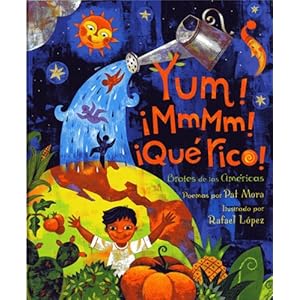
Yum! ¡MmMm! ¡Que´ rico!

Bibliography
Mora, Pat. 2007. Yum! ¡MmMm! ¡Que´ Rico! Lee & Low Books, Inc.: New York. ISBN: 978-0-329-70160-4.


About the Book
This unique collection of Haiku has something for everyone.  On the left of each page is a brief informative description of a food (for example, Potato) giving a probable origin, history, and trivia. On the right page is a Haiku about the edible plants native to the Americas.  The two page illustrations are interesting, intriguing, and appropriate for this genre.  The foods and places highlighted are traditional in the southwest, including Mexico and Texas, among others. The poems capture the flavor of the item in a way children can easily understand. "Chocolate: Fudge, cake, pie, cookies. / Brown magic melts on your tongue." The language used is light and kid-friendly and includes a few simple Spanish words which are defined on the title page verso. Everyone who eats food will enjoy this collection. 

One Poem
Pecan

We crack hard, brown shells,
family munching, story time,
crunch taste of fall.


Activities
*Poetry Break - Using the poem "Pecan." In a transition time, between subjects or while preparing to head out of the classroom, share this short poem.  Discuss the language ('munching') and possible setting (fall).  Also talk about what a family story time might be like - what might the stories be about?

*Bring in familiar and some of the uncommon foods mentioned in the collection.  Research more information about them - where they grow, in what season they are best, etc. - and allow the students to taste samples of each variety. 
*Allow students in the class to vote on their favorite natural foods.  Find out their source and name the food in Spanish. Make a graph depicting the food choices or their origin.
*Grow a simple plant (bean sprout, for example) by allowing each student to place soil and a seed in a cup.  Watch the growth and keep a journal documenting their observations. 
*Read other collections by Pat Mora and compare them to the Haiku included in this collection.